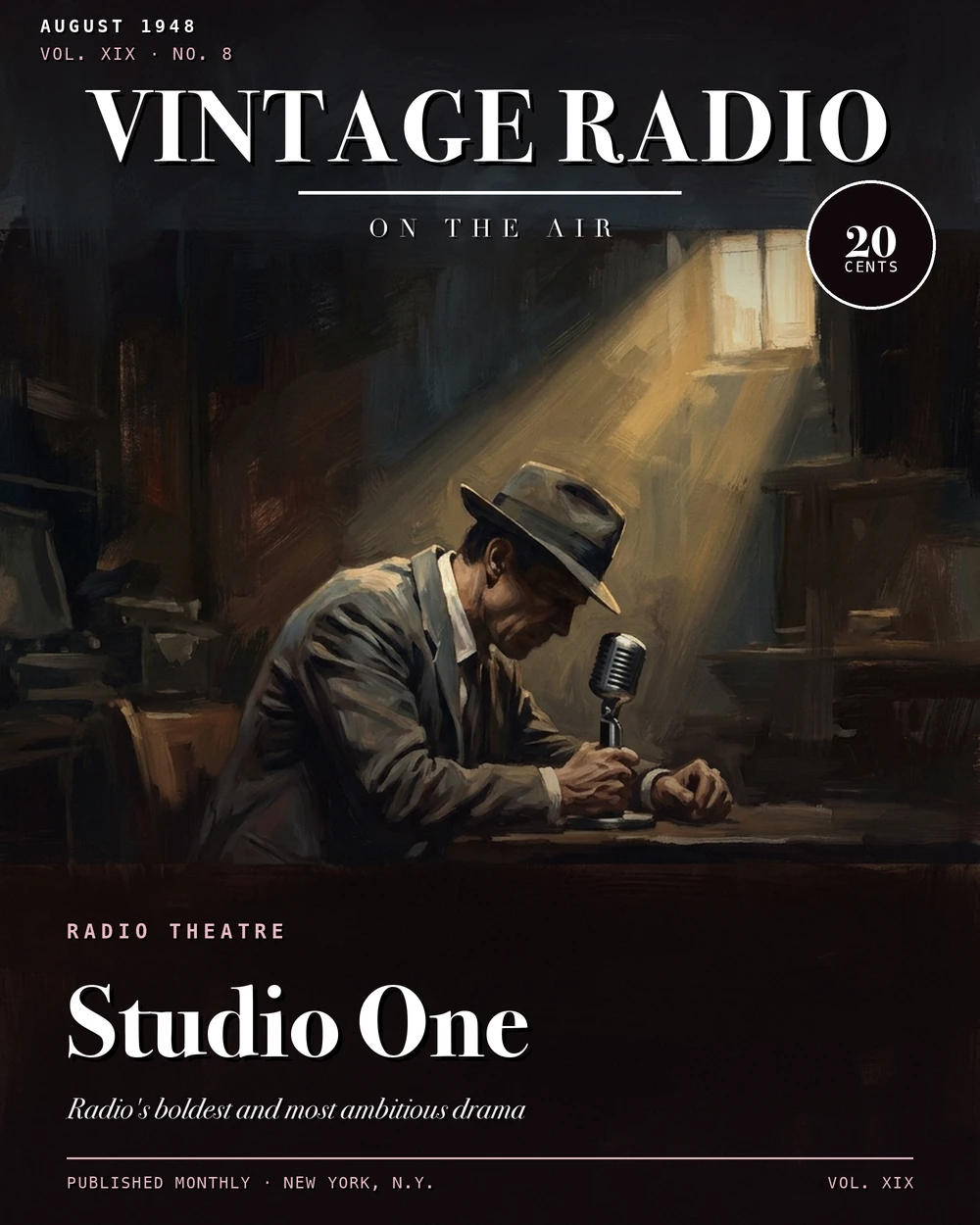
Studio One
The Show and the Man Behind It
Studio One arrived on CBS on April 29, 1947, with something to prove. Its director, Fletcher Markle, was 26 years old, Canadian-born, and operating with a philosophy sharply at odds with how American commercial radio worked. He announced at the outset that Studio One would not use major stars. Instead, it would draw on a rotating repertory company of New York radio actors, adapt serious literary works that had rarely been touched by radio, and treat the source material with enough respect that the adapters were instructed to take as few liberties as possible. The press called it "the most ambitious new series in radio" almost immediately.
Markle had earned his credibility the hard way. He grew up in Vancouver, where a high school drama teacher lit the spark and where he became deeply absorbed in the work of Orson Welles. In 1939, at 18, he left the University of Vancouver and formed a repertory company called the Phoenix Theater — modeled explicitly on Welles's Mercury Theater — staging Welles's modern-dress Julius Caesar and Marlowe's Dr. Faustus. That same year he was already writing radio scripts for local Vancouver stations CKWX and CJOR and for the CBC, working with a troupe that included a young Alan Young. During World War II he served in the Royal Canadian Air Force from 1942 to 1945, continuing to write and direct radio dramas throughout his service, and in 1944 he wrote and narrated the documentary short The V-1: Story of the Robot Bomb, which earned an Academy Award nomination for Best Documentary Short Subject.
After the war, Markle had a small acting role in the British film Journey Together before producer Alexander Korda persuaded him toward Hollywood. He arrived in American radio writing for The Columbia Workshop, then directed and produced Orson Welles's Mercury Summer Theatre on CBS in 1946. He also contributed, without screen credit, to the screenplay for Welles's The Lady from Shanghai. By the time he sat down to build Studio One, he had been working in Welles's shadow long enough to understand both what he admired and what he wanted to do differently. The nickname "the Canadian Orson Welles" followed him through most of his career.
How the Show Was Built
Markle's argument against star casting was rooted in his Canadian and British radio experience. He believed that in those broadcasting cultures there were no stars in the Hollywood sense, yet every performer was a star — and that American audiences had simply been trained to think a program needed a famous name to matter. His alternative was to build listener identification through the work itself, and through an unusual credit system he installed from the beginning: after each broadcast, actors stepped to the microphone and announced the names of their characters, then Markle himself revealed the actors' real names. A small ritual, but it signaled a different set of priorities.
The initial repertory company included Everett Sloane, Anne Burr, Robert Dryden, Paul McGrath, Mercedes McCambridge, Hester Sondergaard, Joe DeSantis, and Stefan Schnabel — experienced radio actors who could carry a 60-minute drama without the machinery of a star turn. The series opened with an adaptation of Malcolm Lowry's Under the Volcano, and the literary shelf it drew from over the run was serious: Dashiell Hammett, Edna Ferber, Thomas Hardy, Prosper Mérimée, Ring Lardner, Henrik Ibsen, Benn Levy, Sinclair Lewis's Dodsworth, Stephen Crane's The Red Badge of Courage, Jane Austen's Pride and Prejudice, and Eugene O'Neill's Ah, Wilderness. Markle's philosophy on adaptation was direct — if you buy a property, you should stick with it, because most writers spent two or more years writing their book or play. The adaptations were mainly skilled cutting aimed at preserving the spirit of the original work. Rights could be acquired cheaply; Markle later recalled obtaining Hemingway rights for approximately one hundred dollars.
Each broadcast had a 20-piece orchestra, with Alfredo Antonini conducting and theme music — "Prelude to the Stars," also known as the "Studio One Concerto" — composed by Vic Oliver. Lee Vines served as on-air announcer throughout the run. Total production costs from the April 1947 launch through the first half of 1948 were estimated at $300,000, and the per-episode budget for guest stars ran to $1,500.
What the Critics Said
The response at the premiere was closely watched and mostly positive, with reservations attached. Jack Gould of The New York Times praised Studio One as "an important and welcome supplement to existing radio fare," commending it for being "not afraid to present drama of controversy and point of view" and singling out the performances of Everett Sloane and Anne Burr. He also warned that Markle's use of special effects sometimes overshadowed the story. Variety's reviewer catalogued the technical flourishes in the opening episode — flashbacks, crowing roosters, rapid scene segues, thunder-and-lightning backgrounds, staccato hoofbeats — and called "much of it distracting."
Media critic John Crosby took a more measured view, finding the first two episodes "ambitious, adult, absorbing, and...very sophisticated drama" while also calling them "jerky, cloudy and over-elaborate" in places, and suggesting Markle was carrying too much himself as director, producer, and writer simultaneously. Magee Adams in The Cincinnati Enquirer was more straightforwardly impressed, comparing the show favorably to Theatre Guild on the Air and writing that "summer schedules will have to soar far above usual form to surpass the new CBS production." The Plain Dealer's radio editor, reviewing the premiere, called it — aside from "a slightly tired introductory scene" — "imaginative and sure," with dialogue described as "strong and purposeful and sharply written" and the cast "exceptionally well cast."
The Peabody Awards committee gave Studio One an Honorable Mention for drama in 1947. The citation praised the program's use of "remarkable material from books, plays, and short stories, preserving the spirit of the original in a production which, at its best, is distinguished for its taste, restraint, and radio craftsmanship."
The Problem That Ended It
Despite the critical recognition, Studio One was fighting from a disadvantaged position almost from the start. CBS programmer Davidson Taylor had placed it in the toughest hour on the air — Tuesday nights at 9:30, directly opposite both Fibber McGee and Molly and The Bob Hope Show. That alone would have suppressed any program's numbers. Adding to the difficulty, the show was unavailable on the West Coast for its first six months on the air. Its Hooper ratings typically ran in the 9–10 range, which made it CBS's highest-rated sustaining — that is, unsponsored — program during its run, but sustaining status meant no commercial revenue to cushion the competition problem. Beginning February 3, 1948, the show shifted to 10:00 p.m. as part of a CBS "mood programming" strategy that established Tuesday as a drama night, but the move did not solve the underlying arithmetic.
As ratings stayed low, Markle eventually did move toward bigger names. Late in 1947, CBS formally instituted a "name talent policy" requiring better-known performers as guest stars. Film actors including Charles Laughton, James Mason, Robert Young, Franchot Tone, and Marlene Dietrich appeared in 1948 episodes, alongside radio performers such as John Garfield, Walter Huston, Burgess Meredith, and Robert Mitchum. An adaptation of Hervey Allen's sprawling Anthony Adverse produced a show that was difficult to follow — too much story to compress into an hour. Not every serious property proved manageable at this scale.
The final blow came from a scheduling decision at the network level. Ford Theater was moving from NBC to CBS, effective October 8, 1948. Billboard identified the arithmetic plainly: Ford's per-episode budget for guest stars was $5,000 against Studio One's $1,500, and Ford's commercial sponsorship would consistently secure better scripts and talent. In July 1948, CBS executives William Paley, Hubbell Robinson, and Frank Stanton discussed relocating Studio One to the West Coast under Harry Ackerman and William Robson, probably converting it to an adventure format — but nothing came of those conversations. Studio One's final radio broadcast aired July 27, 1948, after a run of 64 weeks.
What Came After
In October 1948, CBS announced plans to revive the Studio One title on television, with two episodes per month on Sunday evenings. The television version premiered November 7, 1948, sponsored by Westinghouse Electric Corporation, and ran for 467 episodes over ten seasons before ending September 29, 1958. It broadcast under several variant titles along the way — Westinghouse Studio One, Studio One in Hollywood, Studio One Summer Theatre — and became one of the signature dramatic anthologies of early American television. Markle returned to it in late 1952, replacing Worthington Miner as producer.
Markle's own path after the radio series was varied. He directed Ford Theater as a radio series on CBS from 1948 to 1949, though the network pushed him toward a Hollywood-star format similar to Lux Radio Theatre, which he publicly described as "taking the yellow brick road." He produced and co-wrote the film noir Jigsaw in 1949, then directed The Man with a Cloak for MGM in 1951 with Barbara Stanwyck and Joseph Cotten, and Night into Morning with Ray Milland and John Hodiak the same year. In 1963 he directed The Incredible Journey for Walt Disney. During the 1970s he served as head of television drama for the CBC, and returned to radio in 1978 writing for Sears Radio Theater on CBS. He is also credited with giving Lorne Greene his first American break while producing the Studio One television series — a connection that eventually led to Greene's casting as Ben Cartwright in Bonanza.
Four decades after the radio series ended, Markle recalled Studio One with what he described as fondness and disbelief. Given the competition it faced, the absence of West Coast coverage, and the commercial pressures that eventually forced the star-casting it had been designed to resist, the surprise is not that it lasted only a single season. The surprise is how seriously it was taken while it ran.